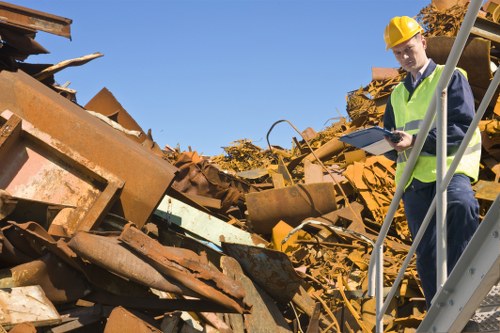
Insurance and Safety for Commercial Waste Removal Leyton
Commercial Waste Removal Leyton customers deserve clear, professional assurance that the team handling their commercial waste is fully covered and follows robust safety systems. As an insured rubbish company operating in Leyton, we prioritise comprehensive coverage, visible documentation and practical risk control so your business can operate without worry. This page explains our public liability commitments, staff training approach, personal protective equipment (PPE) policy and our step-by-step risk assessment process.Public Liability Insurance: Why It Matters
Public liability insurance is the cornerstone of any reputable insured waste removal company in Leyton. Our policy covers third-party injuries and property damage that could occur during collections, transport or on-site disposal. The value of this cover is not just in the premiums — it is in the reassurance it provides clients that, should an incident occur, there is a financial mechanism in place to address claims promptly and fairly. We maintain an industry-standard indemnity limit and can provide proof of cover when requested.
Cover Details and Compliance
- Third-party bodily injury: Protection for any member of the public injured as a result of our operations.
- Property damage: Coverage for accidental damage to client premises, neighbouring properties and municipal infrastructure.
- Transit and site operations: Policies extend to vehicles, lifting equipment and on-site handling while under our control.
Staff Training: Competence, Certification and Continuous Development
Ensuring that crews are skilled reduces risk dramatically. Our workforce is recruited and trained under a documented programme suited to an insured rubbish removal Leyton operation. Training topics include manual handling, safe vehicle loading, segregation of recyclable and hazardous wastes, spill response and emergency first aid. Each operative receives an induction and periodic refresher sessions to keep skills current.
Qualifications and Records
We maintain records for all employees showing:- Induction completion dates
- Qualifications for plant and vehicle operation
- Regular toolbox talks and incident reviews
This documentation demonstrates that our insured waste contractor team in Leyton is competent and that training is part of our ongoing safety culture rather than a one-off activity.
PPE Policy: Standard, Specialist and Site-Specific Gear
Our personal protective equipment programme is designed to match the risks encountered during commercial collections and clearance jobs. From high-visibility clothing and steel-toe boots to gloves, eye protection and respiratory protection where necessary, PPE is issued, maintained and replaced under a controlled system. All staff must wear PPE as directed and supervisors carry out spot checks to ensure compliance.Practical PPE Measures
- Standard issue: Hi-vis jackets, protective boots and work gloves for all crew members.
- Specialist gear: Chemical splash suits, face shields or respirators when handling hazardous or dusty materials.
- Maintenance: Regular inspection logs and replacement schedules to keep equipment effective.
Risk Assessment Process: Systematic, Site-Specific and Documented
Our risk assessment process is systematic and tailored to each job type. For every commercial waste contract we perform a pre-job risk assessment that identifies hazards, evaluates the likelihood and severity of potential incidents, and sets out controls to eliminate or reduce risks. The process aligns with industry best practice for insured commercial waste removal Leyton and is updated whenever new information or changing site conditions require it.
How We Conduct Risk Assessments
- Site survey: A qualified operative or supervisor carries out an on-site inspection to identify trip hazards, vehicle access constraints, overhead obstructions, and potential hazardous waste streams.
- Hazard evaluation: Each identified hazard is scored for likelihood and consequence, producing a prioritised list of risks.
- Control measures: We document practical controls such as traffic management plans, use of mechanical aids, segregation of waste types and PPE requirements.
- Residual risk review: After controls are applied we re-evaluate residual risk and decide whether work can proceed or further measures are needed.
- Record keeping: Completed risk assessments and method statements are retained for audit, client assurance and continuous improvement.
